Posts

Showing posts with the label Ecology

Birding in Maine: North Woods and Warblers
Image
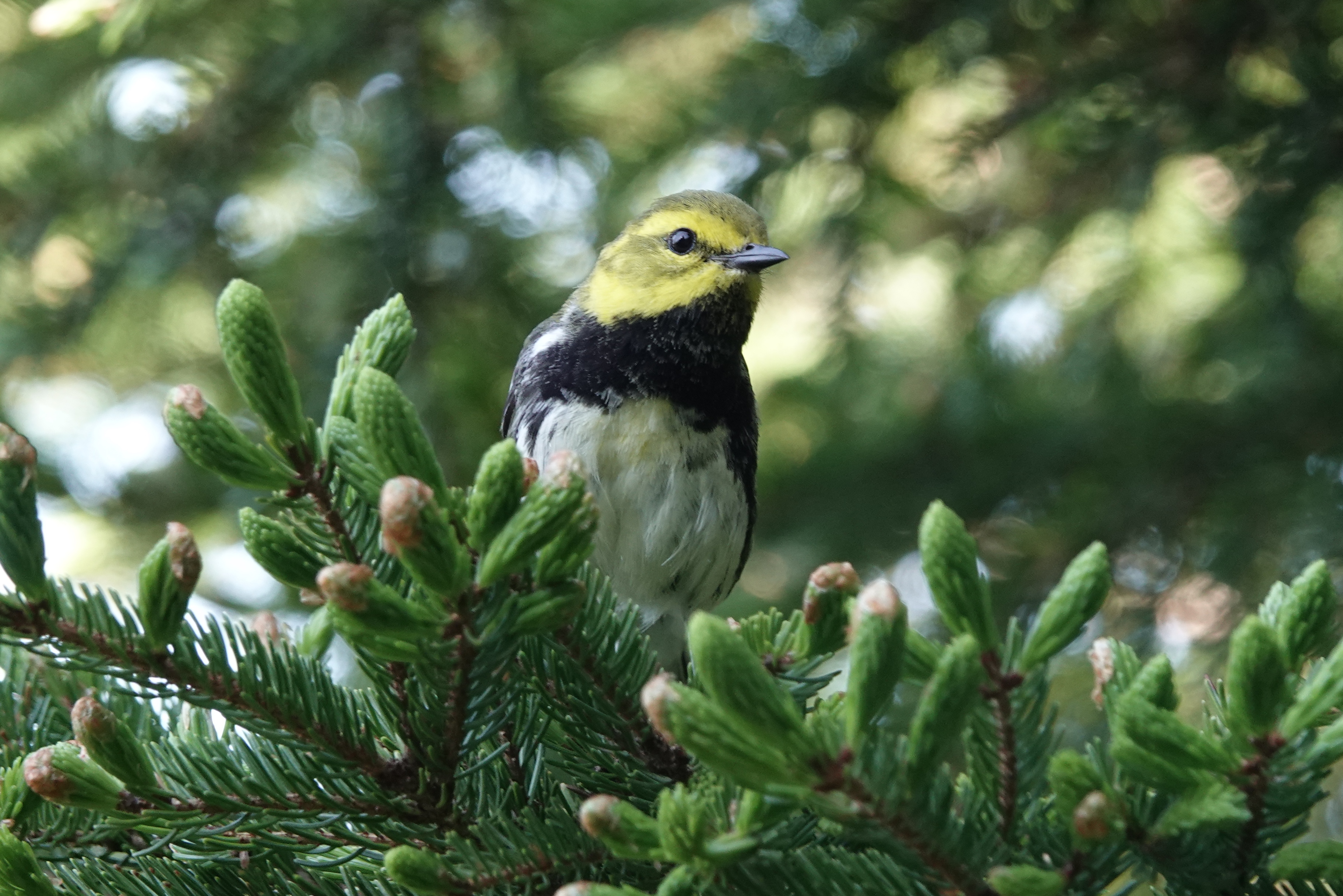
After exploring the salt marshes and rocky coasts of Maine's southern and mid-coast regions, we headed north.  Way north.   Before this final stretch, catch up on the whole series of through New England! Part I: New York Part II: Connecticut Part III: Massachusetts: Fort Hill Part IV: Massachusetts: Race Point Part V: Massachusetts: Plum Island Part VI: Maine's Saltmarshes Part VII: Maine's Rocky Islands & Coast Part VIII: Maine's North Woods Boreal forests beckoned at Baxter State Park, so after several days of exploring gorgeous Mount Desert Island and visiting famed Acadia National Park, we followed highway 95 north from Bangor - north into the woods.   Black-throated Green Warbler One of my birding goals for our June trip to New England was to see as many species of warblers as I could.  Small, agile and active, the New World warblers (also called parulids) are a diverse group of largely insectivorous songbirds in the family Parulidae.  Falli...

The Value of One Valley

Image
On January 26, 2021, a team of scientists from the National Audubon Society published a new study in the journal Ornithological Applications  proving what many birders, naturalists and ornithologists have long suspected: California's Central Valley provides critical habitat for many North American migratory landbirds. The value of Central Valley habitat for waterfowl and shorebirds has long been realized.  The Valley's formerly vast expanses of wetland still provide critical overwintering habitat for millions of migratory waterfowl, including ducks, geese and swans, along with Sandhill Cranes and a number of wading birds and shorebirds.  Other studies have focused on the value of breeding habitat in the Valley for riparian nesting birds.  But until this study, it had not been proven, conclusively, that the Valley also provides critical stopover habitat for a wide array of migratory landbirds as well, a broad group of birds that includes swallows, flycatchers, vireos,...

Summary of Del Puerto Canyon Reservoir Final Environmental Impact Report, Part III

Image
If you've been with me through Parts I  and II of this series, where we talked about the arguments against damming and flooding Del Puerto Canyon and then looked at a long list of sensitive species that may be displaced by the project, you may have a few questions. You may be thinking,  with thousands of acres of habitat available in the Coast Ranges, why would the loss of a mere thousand acres matter?  Isn't there plenty of available habitat left for wildlife?  What is the point of this, anyway? Progress is progress,  you say,  water is life, agriculture feeds the Valley (and many, many far-flung regions beyond), so what is the loss of a thousand or so acres of habitat in the grand scheme of things? Yet this has been the story over and over and over again in California, for the last 200 years: the relentless march of "progress," taking all we can possibly take with little regard for the destruction left behind.   Habitat fragmentation has plague...

Summary of Del Puerto Canyon Reservoir Final Environmental Impact Report, Part II

Image
In Part I , we looked at a few of the reasons the proposed dam at the mouth of Del Puerto Canyon has caused such a great deal of opposition within the local community.  Some of the arguments against the dam include the risk of flooding that a dam failure would present to the city of Patterson, the loss of educational and recreational access to the lower canyon, destruction of Native American cultural sites, and loss of access to sites of geological and paleontological significance. While there are many valid reasons why this canyon should not be flooded, perhaps the most significant to me, as a naturalist, is the loss of wildlife habitat and disruption of wildlife corridors that would follow.   Below are excerpts from the environmental impact report (read the full text  here  and  here ) regarding the specific species of wildlife that have the potential to be displaced by the damming and flooding of Del Puerto Canyon. Regarding terrestrial biological resour...

Summary of Del Puerto Canyon Reservoir Final Environmental Impact Report, Part I

Image
At the western edge of the Great Central Valley, within Stanislaus County, lies a canyon of cultural, biological and geological significance.  A rift in the earth slicing through the Coast Ranges, the canyon exposes millions of years of geologic history, and shows evidence of being occupied by humans long before European settlers arrived on the scene.  A spring at the heart of the canyon feeds into an intermittent stream, bordered by oasis-like pockets of riparian wetlands, cottonwoods, sycamores and ephemeral pools.  In the spring, grasslands within the canyon are verdant with a luxurious covering of new growth and dotted with annual wildflowers, while steep canyon walls are adorned with hardy chaparral and oak scrub habitat.  In the autumn, western sycamores and Fremont cottonwoods lining the creek put on a color show no less spectacular for its subtleness.   This is, of course, Del Puerto Canyon. And this canyon is in imminent danger of being dammed and ...

California's Superlative Trees: The Oldest

Image
California is exemplified by many different landscapes: its sunny beaches, rolling vineyards, granite mountain cathedrals, and vibrant cities, to name a few.  But it is also home to a wide array of forests, which contain a few of the world's most amazing types of plants.  To me, it wouldn't be California without the trees! While California's Coast Redwoods  ( Sequoia sempervirens ) have earned the title of the world's tallest trees, and Giant Sequoias ( Sequoiadendron giganteum ) of the Sierra Nevada are the world's most massive, hands down the winner for the world's oldest trees - and indeed the world's oldest living single organism - goes to the White Mountains' ancient Great Basin Bristlecone Pines ( Pinus longaeva ). While bristlecone pines are found across the Great Basin in parts of Nevada and Utah, the oldest specimens, many of which exceed 3,000 years, grow in the harsh conditions of eastern California's White Mountains.  The Methusel...

About Me

Named after the Sierra Nevada Mountains, I am a naturalist and avid birder based in Central California. Above all, I am a follower of Jesus Christ, our amazingly good Creator God whose magnificent creation is an unending source of awe and inspiration for me. I hope to inspire others to appreciate, respect and protect this beautiful earth we share, and invite you to come along with me as I explore the nature of California and beyond!
- Siera Nystrom -