Posts

Great Egret at CSU Stanislaus

Image
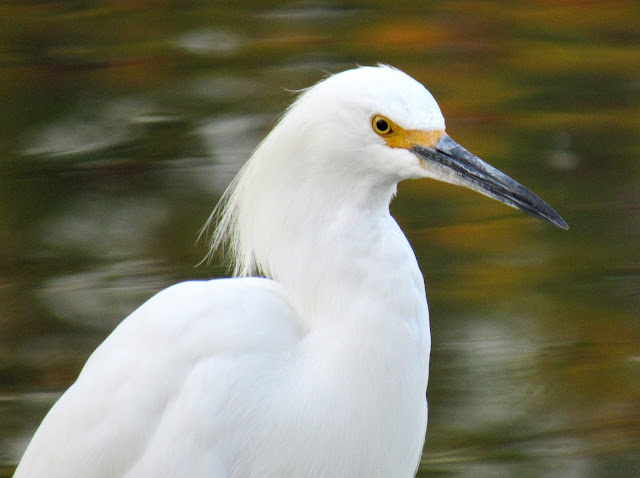
Since a few days ago I mentioned the snowy egret ( Egretta thula ) that lives on the campus of CSU Stanislaus, I thought I'd go ahead and add a post about a pair of great egrets ( Egretta alba ) which share the same ponds. But first : how to distinguish between the two species of white egrets commonly seen in California. I was lucky enough to get this shot of both species standing side by side for an excellent comparison. Compare: size difference, feet color, bill color The most obvious difference is their size; the great egret is, fittingly, significantly larger than the snowy egret.  However, as any birder will tell you, never judge a bird on size alone!  Perceived size, dependent on many variables, can be deceiving.  That is why it is valuable to learn field marks. Great egret, with yellow bill and black feet Noteworthy field marks for the snowy egret are its black bill, black legs and yellow feet.  Looking at just the fe...

Geology of Natural Bridges, Calaveras County

Image
In Calaveras County, on Parrot's Ferry Road between the towns of Columbia and Angel's Camp, is an impressive geologic formation, a set of "natural bridges" over Coyote Creek that are more like the area's caverns than they are like other natural bridges or arches of the California coast or desert southwest.  They are a little taste of the Mother Lode's karst topography - something not very typical of California.  Karst caverns form when acidic water erodes underlying rock composed of limestone or marble.  Limestone is a sedimentary rock composed of calcium carbonate fossils deposited at the bottom of a body of water, which over time solidifies into rock; marble is the metamorphic rock limestone is transformed into after undergoing the intense heat and pressure of natural geologic processes, such as subduction, that is great enough to recrystallize the rock.  As the softer rock is eroded, hidden cavern systems form below ground.  At tim...

A California Endemic - Nuttall's Woodpecker

Image
These little guys are pretty special, rather adorable, and found only in California.  The Nuttall's Woodpecker ( Picoides nuttallii ) is a small woodpecker found almost exclusively in California's oak woodlands and riparian habitat.  It is most similar in appearance to the ladder-backed woodpecker ( Picoides scalaris ) of the southwestern deserts, but their ranges don't overlap.  It can be distinguished from the similarly-sized Downy and Hairy Woodpeckers of California ( P. pubescens and P. villosus )  by the absence of a white patch on its back. Male Nuttall's Woodpecker ( Picoides nuttallii ) in the dead upper branches of an oak. I've been lucky in finding these little woodpeckers, and I see them often along the Tuolumne River near Waterford.  But, much closer to home, a good-sized population of Nuttall's woodpeckers resides on the campus of CSU Stanislaus.  The day I took these photos, three Nuttall's Woodpeckers were in one tree! Note the ch...

Snowy Egret at CSU Stanislaus

Image
This particular snowy egret ( Egretta thula ) seems to have taken up permanent residence at CSU Stanislaus, dividing his (or her) time between two ponds : Willow Lake, near the science buildings, and Warrior Lake, near the Faculty Development Center.  Both of these ponds have a portion of their shores planted with reedy grasses or cattails, which provide some measure of "natural-feeling" habitat for egrets (and herons too).  The ponds both contain at least two or three types of fish (I haven't done a full survey of all the fish species present!), introduced red-eared slider turtles, and crayfish, among other aquatic creatures, I'm sure. Snowy egret ( Egretta thula ), showing slender black bill and yellow lores (area between the bill and eyes on each side of the head) characteristic of this species.  The lores will briefly turn red at the height of the breeding season. The diet of snowy egrets consists primarily of fish and small aquatic animal...

Foray into Geology : The Long Valley Caldera

Image
*Disclaimer : I am not a geologist; I don’t have a geology degree, I never majored or minored in geology.   I've taken exactly one college geology class, and I've read three books on geology - four, if you want to count the one I read twice.   (More on those gems in another post, no pun intended.)   But I'm learning.   And since California is such a geologically rich place, it's the perfect learning ground.    Therefore, what you read here is just that : a glimpse into a learning process, as I study and read and glean information from my travels to sites of geologic significance, then share my findings with you.   Please correct me if anything is amiss! During the summer of 2015, my husband and I spent a week in the Mammoth Lakes area, on the breathtaking eastern side of the Sierra Nevada.   The cabin where we stayed was perched on the edge of the Long Valley Caldera, below Mammoth Mountain, in the Lakes Basin region of Mammoth Lakes.   (...

Favorite Places : From the High Sierra to… Stanislaus State University?

Image
I have so many favorite places to explore, it's impossible to choose just one.   California offers a wealth of treasures for the naturalist, from alpine peaks to below-sea-level deserts and everything in between.   Looking east toward the High Sierra, from the top of Clouds' Rest in Yosemite National Park I enjoy the High Sierra as much as I enjoy the rocky coast, and redwood forests dripping with fog are just as enticing as deserts blooming in spring.   Rocky intertidal zone around Asilomar State Beach Conveniently, the varied forests, coasts and deserts are all within a few hours' drive of the Central Valley, and I have been blessed with many opportunities to explore these rich and diverse ecosystems.   Mojave National Preserve after a spring storm, near Banshee Canyon But, where do I go on an average day, when I only have time for a short walk? T hankfully, I can still practice my naturalist skills close to home...

Western Kingbirds Near Hornitos

Image
Trio of juvenile Western Kingbirds ( Tyrannus verticalis ) near the town of Hornitos, Ca Members of the Tyrant Flycatcher family, Tyrannidae, Western Kingbirds ( Tyrannus verticalis ) catch flying insects on the wing, hunting during daylight hours.   They inhabit much of the Central Valley during the summer months, preferring open habitats such as low elevation grasslands, open woodlands, sagebrush and agricultural land. Western Kingbirds, in the branches of a Blue Oak ( Quercus douglasii ) I heard this trio of three juvenile Western Kingbirds before I spotted them, huddled together in a blue oak ( Quercus douglasii ) earlier this summer.   Their mother was not far off, flying back and forth catching insects to feed to her not-yet-independent offspring.   Looking towards their momma, returning with supper I sat on the ground under the tree and watched these little ones for quite some time as they bobbed up and down with their branch swaying in...

About Me

Named after the Sierra Nevada Mountains, I am a naturalist and avid birder based in Central California. Above all, I am a follower of Jesus Christ, our amazingly good Creator God whose magnificent creation is an unending source of awe and inspiration for me. I hope to inspire others to appreciate, respect and protect this beautiful earth we share, and invite you to come along with me as I explore the nature of California and beyond!
- Siera Nystrom -