Snowy Egret at CSU Stanislaus
This particular snowy egret (Egretta thula) seems to have taken up permanent residence at CSU Stanislaus, dividing his (or her) time between two ponds : Willow Lake, near the science buildings, and Warrior Lake, near the Faculty Development Center. Both of these ponds have a portion of their shores planted with reedy grasses or cattails, which provide some measure of "natural-feeling" habitat for egrets (and herons too). The ponds both contain at least two or three types of fish (I haven't done a full survey of all the fish species present!), introduced red-eared slider turtles, and crayfish, among other aquatic creatures, I'm sure.
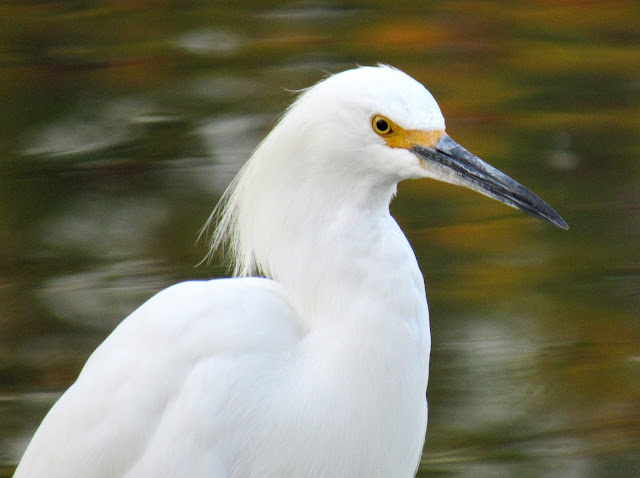 |
Snowy egret (Egretta thula), showing slender black bill and yellow lores (area between the bill and eyes on each
side of the head) characteristic of this species. The lores will briefly turn red at the height of the breeding season. |
The diet of snowy egrets consists primarily of fish and small aquatic animals, such as frogs, crustaceans and insects, which they spear with their bills. Snowy egrets are commonly associated with shallow coastal wetlands, though they are quite at home here in the Central Valley year-round. Like other herons and egrets (family Ardeidae), these birds nest colonially, though I've only ever seen one snowy egret at a time on campus.
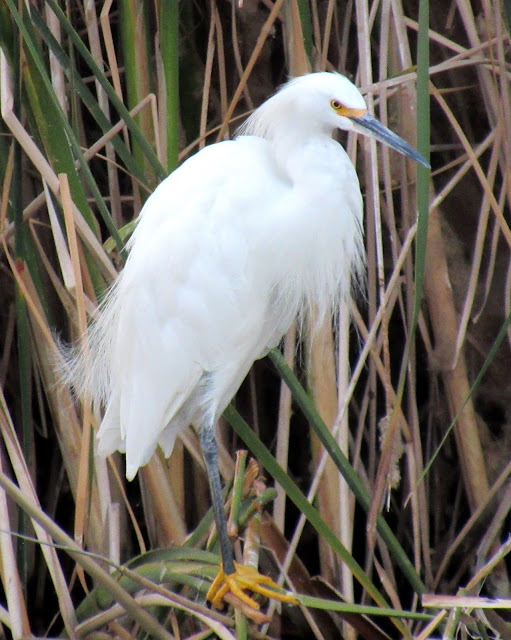 |
Showing the once-coveted breeding plumes, as well as characteristic yellow feet.
The similar but considerably larger great egret (Ardea alba) has a yellow bill and black feet.
Always look for the snowy's yellow shoes! |
In the late 1800's and early 1900's, the soft, billowy plumes of feathers which egrets grow during the breeding season became all the rage for decorating ladies' hats, and the value of these feathers temporarily surpassed that of gold. Consequently, plume-hunters sought the birds, killing them for their feathers, and the population of snowy egrets declined drastically. Only through the work of conservationists has the species recovered. These early efforts to save the snowy egret paved the way for the conservation movement as we know it today.
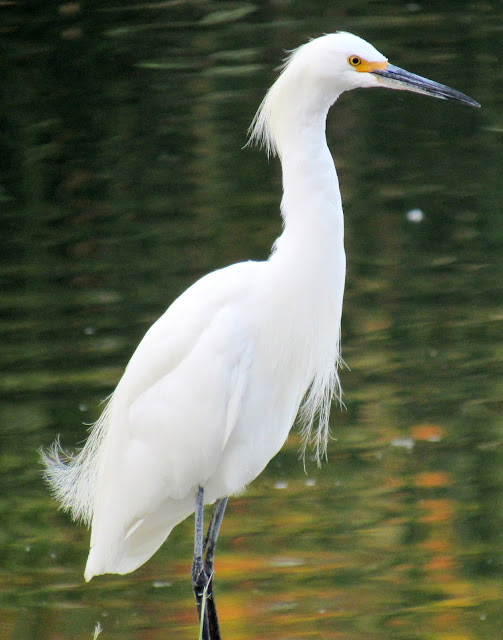 |
Another look at the lovely breeding plumage (though this photo was taken in September, toward
the end of the breeding season). |
About Me
Named after the Sierra Nevada Mountains, I am a naturalist and avid birder based in Central California. Above all, I am a follower of Jesus Christ, our amazingly good Creator God whose magnificent creation is an unending source of awe and inspiration for me. I hope to inspire others to appreciate, respect and protect this beautiful earth we share, and invite you to come along with me as I explore the nature of California and beyond!
- Siera Nystrom -
You Might Also Like:
California is certainly a special place. A treasure trove of natural wonders and beauty, the state encompasses one of the world's hotspots of biodiversity . But what makes California so remarkable, so rich in endemic plants and animals found nowhere else in the world? There have been a couple of key factors at work in this mountainous West Coast state through the ages, shaping it into what it is today: one of those factors is its unique climate, and the other is its diverse topography and underlying geology. Today, we'll take a look at California's very special climate. A quintessential Californian landscape - golden, oak-dotted hills - inside the now-imperiled Del Puerto Canyon, a hotspot for biodiversity, endemism and really neat geology in the central Coast Range. The mild, Mediterranean climate of California is shared by only four other regions in the world: central Chile, the southwestern tip of South Africa, southwestern Australia, and the Mediterra...
I am fortunate enough to live within about a two-hour drive of the Pacific Coast (which is far enough away to avoid the traffic and potential earthquake damage, but close enough for day trips!). Some of my earliest and fondest childhood memories involve days spent on the beach at Carmel, and entire weekends and weeks spent along the rocky shore in Pacific Grove with my dad, building sandcastles and poking around in tide pools. Until I began birding seriously a few years ago, most of my time along the coast was spent like this: Following in the footsteps of "Doc" Ed Ricketts: tide-pooling in Monterey's Great Tide Pool area ... Looking for things like this: Hermit Crab ... And this: Anemone ... And this: California Sea Hare (found already dead, washed up on the beach) I was aware of "seagulls" and "sandpipers," maybe even vaguely aware of that mystical group known as the "sea birds" which exist somewhere out the...
"Day 37. The Cranes still do not suspect that I am a Heron. The plan is working. I shall continue to blend in with their herd." While birding at Merced National Wildlife Refuge, I came upon this rather amusing scene. Well, amusing if you're a birder, I suppose... No great scientific insights here (other than to say that these two species, the Great Blue Heron and Sandhill Crane, can clearly co-exist quite peaceably). Just a funny photo! Oh, but as a side note, flocks of Sandhill Cranes really are called herds. And the young are known as colts. There are your facts for the day! (I couldn't help myself.)
Riparian forests are invaluable in all regions and climates around the world, but as one might imagine, they are especially critical in arid regions like southeastern Arizona. While a plethora of bird species cluster along the rivers, breeding in the complex, multi-level gallery forests, even more incorporate these riparian corridors into their migratory pathways. With this in mind, I knew that a good portion of our time birding in southeastern Arizona would need to be spent along such rivers, and we found a few locations that lived up to their reputations as particularly good spots to find neat birds. (In case you missed it, in Part I of this series, we visited Madera Canyon .) The San Pedro River, near Sierra Vista The Santa Cruz River, which we visited near Tubac, has its headwaters in high grasslands to the east of the town of Patagonia. From there, it flows south into Mexico before changing its course to flow north past Tucson where it eventually ...
So far on our journey of designing a garden using California native plants, steps one through five have been pretty heavy on the planning end of things. We've barely even touched the soil yet! But now that we have our final planting plan in place and have created our shopping list, it's time to get to work! The weather is warming up, spring weeds plants are flourishing, and dormant grasses (like the nefarious Bermuda grass) are coming back to life in gardens everywhere. With spring in full swing, now is the ideal time to consider removing your lawn to make room for a native plant garden! If you need a refresher, here are links to steps 1 through 5 in the Designing a Native Garden series: 1: Research 2: Site Analysis 3: Visit Gardens 4: Native Plant Nurseries 5: Create A Planting Plan Step 6: Site Preparation (Lawn Removal, Hardscaping and Irrigation Advice) The toughest part of this whole project is this step - especially if you're facing the task of remo...
Several times this year I have been lucky enough to see North American River Otters ( Lontra canadensis ) in both the San Joaquin and Tuolumne Rivers. They have been too leery of me to allow for any great National Geographic quality photos (let's be honest, that's not entirely the otters' fault!) but I have gotten a few shots in which they are at least recognizable as river otters, not just obscure brown blobs on the riverbank! River Otter along the banks of the Tuolumne River. The presence of otters in our rivers is a wonderful thing. As a top predator species in the ecosystem, river otters are often heralded as indicators of the health of the entire watershed. Like their seafaring counterpart, California's Southern Sea Otter ( Enhydra lutris nereis ), the North American River Otter was once hunted extensively for its thick pelt. Where otters once thrived, over hunting, followed closely by habitat loss and degradation, has taken...



Comments
Post a Comment