Posts

Blue-gray Gnatcatchers and the Gray Days of Winter

Image
Winter may be a cold and dreary time of year across most of North America, when trees are bare and skies are gray, but here in California's Great Central Valley, winter is an excellent time for birding and exploring the woods and wetlands close to home.  Because despite the cold, the birds are out there in abundance! Last week, while birding at the San Joaquin River National Wildlife Refuge, I was delighted to encounter quite a few Blue-gray Gnatcatchers out and about along the trail.  These little dynamos were out in force all day, calling emphatically from the shrubby growth as they flitted actively from twig to twig. Blue-gray Gnatcatcher These little birds' small size (they're only about four inches long), active habits and predilection for staying deep in their shrubby habitat can make them difficult to get good looks at, much less photograph!  (Just take a look at how unsuccessful I have been in the past !)  But this guy was pretty cooperative, moving about and...

A Conservation Success Story in the Making: California Brown Pelican

Image
With all the less-than-great news floating around out there these days about the future of the environment in general, and birds in particular, it's refreshing to pause and reflect on the success stories the world of conservation has seen in the fifty years since the implementation of the Endangered Species Act in December of 1973. While human activity has undoubtedly caused bird populations to decrease drastically in that span of time, (and sadly those numbers may continue to drop) conservationists across North America have managed to make some pretty incredible changes for the better for a number of species as well.  The Endangered Species Act has protected over 1,600 species in its fifty-year history, and is credited with saving nearly 300 species from extinction.     The California Condor is one such example, a species that would be gone today if it weren't for the incredible work of a massive team of researchers and conservationists.  Other success stori...

Miniature Mites of the Pines: Pygmy Nuthatches in Monterey

Image
For your daily dose of adorable, and to liven up the dreary days of winter, have a look at this family of Pygmy Nuthatches I encountered last July while birding on the coast near Carmel! Juvenile Pygmy Nuthatch in a Monterey Cypress Tipping the tiny scales at about one-third of an ounce (or around nine grams, the equivalent weight of nine paperclips), Pygmy Nuthatches are the smallest of the four North American species of nuthatch.  Though small, these little mites of the pines make their presence known as they call to each other with an incessant series of high-pitched piping notes that has been likened to a rubber ducky being squeezed.  Often, this sound pelting down from the treetops is the first indication that these active little birds are in the area. Juvenile Pygmy Nuthatch, begging for food. Juvenile Pygmy Nuthatch, awaiting its meal delivery. Pygmy Nuthatches do everything together: they breed cooperatively, with relatives helping a mated pair raise its brood of up t...

Losing Ground: Mountain Plover in California's Central Valley

Image
Christened the "Rocky Mountain Plover" in 1834 by John James Audubon, the Mountain Plover, as it is now called, is actually a bird of short grass prairies rather than true mountain habitats.  Named for its breeding range in the Rocky Mountain region of the United States, specifically in parts of Colorado, Wyoming and Montana, a large percentage of Mountain Plovers spend a significant portion of their lives in California, where they winter on remnants of grassland, alkali flats and, most notably, plowed and fallow agricultural fields. The Mountain Plover is a habitat specialist, adapted to life on short grass prairies and other areas of bare ground and sparse coverings of very short vegetation.   And in California, the bare ground that Mountain Plovers need to survive is rapidly dwindling. Mountain Plover, Yolo County California, January Almost exclusively insectivorous, Mountain Plovers spend their entire lives on the ground, scurrying along with a distinctive run-and-sto...

The Weird and Wonderful World of Sea Ducks

Image
"What makes a duck a duck?" This question was posed to me the other day by a friendly gentleman who stopped to chat as I stood behind my spotting scope, peering over massive swells and crashing waves at a distant flock of dark specks bobbing on the surface of the water beyond the breakers.  These specks, I had informed him, were ducks.  More specifically, they were a delightful collection of three species of scoter, a highly specialized type of sea duck designed for life on the rugged, wave-battered coast.   Those are ducks?   I could feel the skepticism.   Yes, ducks.  But not dabbling puddle ducks, like the familiar Mallard, or even hardy diving ducks, like scaup.   These are sea ducks! Surf Scoters in Monterey Bay, off the coast of Moss Landing, California.  July. I answered his question the best I could with somewhat divided attention: Biology, physiology, behavior and life history all combine to make a duck a duck, so that even...

Happy Christmas!

Image
Happy Christmas, fellow naturalists and lovers of all things wild and beautiful!   This Christmas season, may you enjoy and savor the dazzling natural beauty that abounds just outside our doors, even through the depths of winter: frosty mornings, sparkling snow on evergreens, winter birds at the feeders, late sunrises and early sunsets. May you connect deeply with loved ones, creation, and most importantly its Creator, who came to be Immanuel, God with us, Jesus Christ, our Light who shines even in the darkest days of the year! Northern Mockingbird with Toyon (otherwise known as California Christmas berry!) And, as a special gift from me to you, please enjoy this little bit of Christmas corniness and cheer:  A California Birder's 12 Days of Christmas "On the first day of Christmas, my birder gave to me, A Pine Siskin eating thistle seeds. "On the second day of Christmas, my birder gave to me, Two Mourning Doves, And a Pine Siskin eating thistle seeds. "On the third d...

Belted Kingfisher: 2023 ABA Bird of the Year

Image
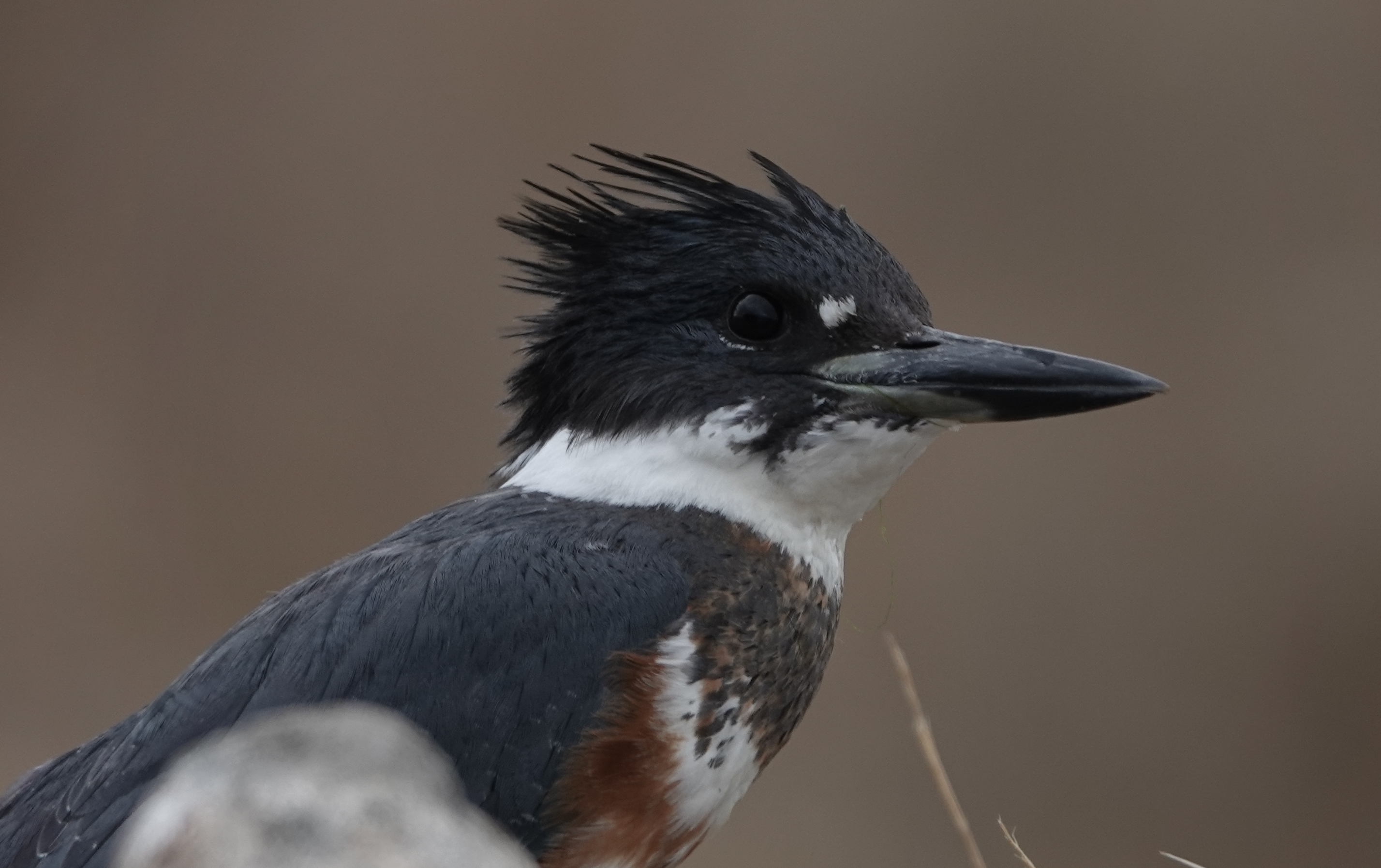
As 2023 winds down, it seems fitting that I share a few photos, recently obtained, of a somewhat elusive but common bird across the entire North America continent.  Named this year's Bird of the Year by the American Birding Association, the Belted Kingfisher is an impressive presence just about anywhere there is a calm, clear body of water in which it can hunt, preferably with some cover at the edges and handy perches nearby.   Perched strategically over the water, kingfishers scan for prey, which includes a wide variety of fish, crustaceans, amphibians, and even small mammals.  Once a hunting kingfisher has sighted her target, she dives, bill-first, into the water to nab said prey item.  Held fast in her bill, she brings her meal triumphantly back to her perch, where she proceeds to beat it soundly against the branch before swallowing it whole.  Super amusing to watch. Kingfishers may also hover or "kite" over a body of water in search of prey, which is a...

About Me

Named after the Sierra Nevada Mountains, I am a naturalist and avid birder based in Central California. Above all, I am a follower of Jesus Christ, our amazingly good Creator God whose magnificent creation is an unending source of awe and inspiration for me. I hope to inspire others to appreciate, respect and protect this beautiful earth we share, and invite you to come along with me as I explore the nature of California and beyond!
- Siera Nystrom -